
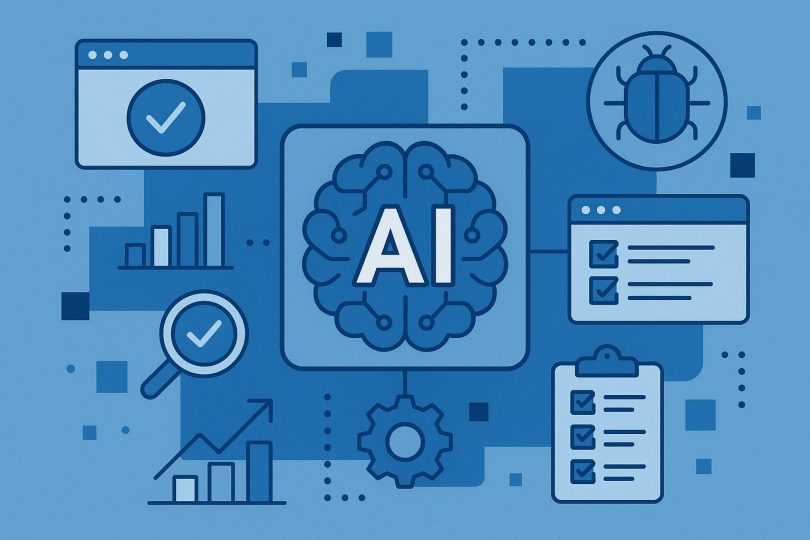
Software teams are under constant pressure to release faster while maintaining quality. At the same time, budgets and hiring plans often remain flat. This creates a challenge for QA leaders: how can test coverage improve when the number of testers stays the same?
Artificial intelligence is emerging as one of the most effective answers. Rather than replacing QA professionals, AI helps teams work more efficiently by identifying gaps, generating test scenarios, uncovering edge cases, and analyzing requirements at a scale that would be difficult to achieve manually.
As organizations continue to accelerate software delivery, AI-powered testing practices are helping teams expand coverage without adding headcount.
The Growing Challenge of Test Coverage
Modern applications are more complex than ever. Teams must validate functionality across multiple browsers, devices, operating systems, APIs, integrations, and user journeys. Every new feature introduces additional testing requirements, while release cycles continue to shrink.
Traditional approaches often lead to difficult tradeoffs:
- Prioritize critical paths and leave less common scenarios untested
- Increase manual testing effort, resulting in higher costs
- Delay releases while testing catches up
- Accept greater risk of defects reaching production
AI helps eliminate many of these compromises by automating some of the most time-consuming aspects of test design and analysis.
Automated Scenario Generation
One of the biggest bottlenecks in testing is creating comprehensive test cases. Testers must analyze requirements, identify user workflows, and design scenarios that validate expected behavior.
AI can accelerate this process by generating testing scenarios directly from requirements, user stories, acceptance criteria, and existing documentation.
Instead of manually brainstorming every possible workflow, teams can use AI to:
- Generate positive and negative test cases
- Create variations of user journeys
- Suggest missing validation scenarios
- Expand coverage for newly added features
- Identify alternative user paths
For example, modern large language models can analyze a login requirement and generate dozens of related test scenarios involving password validation, account lockouts, session management, error handling, and authentication edge cases.
Organizations exploring AI-generated testing scenarios are finding that AI serves as a valuable assistant during test planning, helping teams identify opportunities that might otherwise be overlooked.
Discovering Edge Cases at Scale
Edge cases are often responsible for the most costly production defects.
The challenge is that humans naturally focus on common user behaviors. Rare combinations of inputs, unexpected workflows, and unusual system states can easily escape manual test design.
AI excels at exploring possibilities beyond the obvious.
Examples include:
- Invalid input combinations
- Boundary value conditions
- Unusual user sequences
- Timing-related interactions
- Error recovery scenarios
- Integration failures between systems
Because AI can rapidly generate and evaluate large numbers of possibilities, teams can uncover hidden risks earlier in the development lifecycle.
This capability becomes especially valuable in complex enterprise systems where the number of potential user interactions grows exponentially.
Requirements Analysis and Gap Detection
Poorly defined requirements are one of the leading causes of defects. Ambiguous language, missing acceptance criteria, and incomplete specifications frequently result in misunderstood functionality.
AI can assist by reviewing requirements before development begins.
Common use cases include:
- Identifying ambiguous statements
- Highlighting missing business rules
- Detecting inconsistent requirements
- Suggesting additional acceptance criteria
- Mapping requirements to test cases
When requirements are analyzed early, teams can prevent coverage gaps from appearing later in the testing process.
Instead of discovering missing scenarios during execution, QA teams can proactively address them during planning.
Faster Coverage Expansion Without Additional Resources
Traditionally, increasing test coverage required one of two things:
- More time
- More people
AI introduces a third option: greater efficiency.
By automating portions of test design and analysis, QA professionals can spend less time on repetitive activities and more time on:
- Exploratory testing
- Risk assessment
- Test strategy development
- User experience validation
- Complex business workflows
This allows organizations to increase coverage while keeping team sizes relatively stable.
The result is not fewer testers. Instead, it is testers who can focus their expertise where human judgment creates the most value.
Understanding the Limitations
Despite its advantages, AI is not a complete replacement for human testers.
AI-generated test cases still require review and validation. Generated scenarios may include redundant cases, misunderstand business context, or miss organization-specific requirements.
Successful teams treat AI as a force multiplier rather than a substitute for QA expertise.
Human testers remain essential for:
- Understanding business objectives
- Evaluating user experience
- Prioritizing risks
- Validating generated outputs
- Making strategic testing decisions
The strongest testing programs combine AI-driven automation with experienced QA professionals.
Real-World Applications of AI-Powered Test Generation
Many QA teams are already using large language models to assist with test design and coverage expansion.
Tools such as Claude can help generate test cases, analyze requirements, and propose additional scenarios that improve overall test coverage. However, understanding both the strengths and limitations of these models is critical for successful implementation.
For practical examples and a deeper look at Claude’s test generation capabilities, read this guide from testRigor.
The article explores real QA use cases, benefits, limitations, and considerations when incorporating Claude into software testing workflows.
The Future of AI-Assisted Quality Assurance
As AI technology continues to evolve, its role in software testing will expand beyond scenario generation and requirements analysis.
Future capabilities will likely include:
- Smarter risk-based testing recommendations
- Automated coverage analysis
- Self-updating test suites
- Improved defect prediction
- Enhanced root cause analysis
Teams that adopt AI strategically today will be better positioned to maintain high-quality releases while managing growing software complexity.
Conclusion
Improving test coverage has traditionally required additional resources, longer timelines, or larger QA teams. AI is changing that equation.
By assisting with automated scenario generation, edge-case discovery, and requirements analysis, AI helps organizations expand testing coverage without significantly increasing headcount.
The most successful teams are not replacing testers with AI. They are empowering testers with AI, enabling them to focus on higher-value work while improving the overall quality of their software.
For professionals interested in understanding how AI is transforming not only software testing but also marketing, operations, analytics, and other business functions, NeuroBits AI provides insights, research, and practical resources covering the broader impact of artificial intelligence across industries.